Why Advanced Busbar Machines Matter in Electrical Manufacturing
Rising Precision Demands in Modern Workshops
Electrical equipment manufacturers require strict dimensional accuracy when they process copper and aluminium busbars. Even slight deviations affect installation quality and conductivity. Therefore, factories adopt advanced busbar machines to ensure precise bending and punching results.
Moreover, digital control systems guide every movement. These systems reduce manual errors and keep each busbar aligned with engineering drawings. As a result, production quality improves and material waste declines.
From Manual Operation to CNC Efficiency
Previously, technicians relied on manual measurement and personal experience. However, CNC busbar processing machines now execute complex tasks with programmable precision. Operators enter parameters once, and the system repeats the work consistently.
Consequently, factories increase output while maintaining stable quality across production batches.
Copper, Aluminium, Hydraulic, and CNC Bending and Punching Solutions
Copper Busbar Bending Machine and Punching Machine
Copper demands controlled force during bending to prevent cracks and surface damage. A copper busbar bending machine forms accurate angles while protecting material integrity. In addition, a copper busbar punching machine creates clean holes with precise spacing, which simplifies assembly.
Furthermore, CNC positioning ensures that each bend and hole follows design specifications exactly. This accuracy supports switchgear and transformer production lines.
Aluminium and Hydraulic Busbar Equipment
Aluminium shows higher elasticity than copper, so manufacturers use an aluminium busbar bending machine with calibrated tooling. This setup prevents deformation and preserves strength. Meanwhile, a hydraulic busbar bending machine delivers stable pressure for thick materials used in high-voltage systems.
Similarly, a hydraulic busbar punching machine handles heavy-duty punching tasks with reliability and long service life.
CNC Busbar Bending and Punching Machine for Complex Work
A CNC busbar bending machine handles intricate angles and repetitive jobs effortlessly. At the same time, a CNC busbar punching machine performs high-speed hole processing with consistent accuracy. Therefore, factories shorten production cycles without sacrificing quality.
Portable Machines, Pricing Factors, and Integrated Solutions
Portable Busbar Bending Machine for On-Site Tasks
Technicians sometimes need to modify busbars directly at project sites. A portable busbar bending machine provides this flexibility. Workers complete adjustments immediately, which reduces delays and improves installation efficiency.
Despite its compact size, the machine supports common busbar dimensions used in electrical panels.
Busbar Bending Machine Price and Value Evaluation
Busbar bending machine price depends on CNC functions, hydraulic power, and tooling configuration. Although advanced equipment requires higher investment, it reduces labor intensity and improves long-term productivity.
Therefore, manufacturers evaluate machines by overall operational value instead of initial cost.
Integrated CNC Busbar Processing Machine from LiJian®
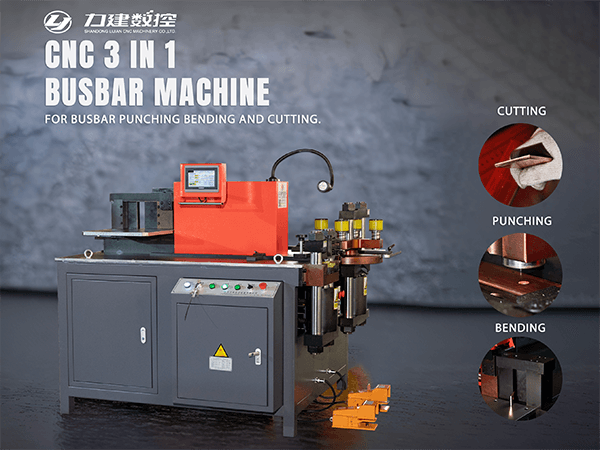
LiJian® busbar machine offers integrated CNC busbar processing machines that combine bending, punching, and cutting on one platform. This design reduces material handling and saves workshop space. In addition, operators complete multiple processes efficiently within a single system.
Conclusion: Choosing the Right Busbar Machine for Higher Productivity
Selecting the proper busbar machine directly affects fabrication accuracy and production speed. Copper and aluminium processing require specialized bending and punching solutions. Meanwhile, CNC and hydraulic technologies deliver the precision and power modern factories expect.
With advanced solutions from LiJian® busbar machine, manufacturers improve efficiency, maintain consistent quality, and meet growing electrical industry demands.