Integrated Technology for Modern Busbar Fabrication
In contemporary electrical manufacturing, precision and efficiency determine production success. Busbars serve as the conductive backbone of switchgear, control panels, and power distribution systems. Therefore, manufacturers increasingly adopt advanced fabrication equipment that can deliver consistent geometry, high throughput, and stable performance.
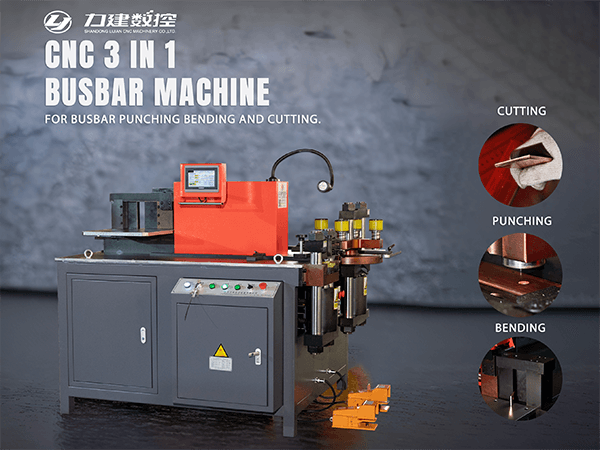
The LiJian® 3 in 1 busbar machine represents a significant advancement in integrated busbar processing technology. By combining punching, bending, and cutting functions within a single CNC-controlled platform, this equipment streamlines fabrication workflows while maintaining strict dimensional accuracy. As a result, manufacturers can transform raw copper or aluminum bars into complex conductive components with minimal intermediate handling.
Moreover, the consolidation of multiple operations into one system improves operational continuity. Instead of transferring workpieces between several machines, operators complete sequential processes within a unified manufacturing environment. This integration not only enhances productivity but also reduces cumulative tolerance deviations, thereby ensuring superior alignment in electrical assemblies.
Core Technical Architecture of the LiJian® 3 in 1 Busbar Machine
CNC-Controlled Multi-Process Coordination
At the operational core of the LiJian® 3 in 1 busbar machine lies a sophisticated CNC control system. This digital platform governs punching, bending, and cutting sequences through programmable instructions derived directly from engineering designs. Consequently, fabrication processes follow predetermined coordinates and parameters with remarkable precision.
Operators can input busbar layouts through the control interface, where the system interprets dimensional data and translates it into synchronized machining operations. Each step of the fabrication cycle occurs within a coordinated framework, ensuring that hole positions correspond accurately with subsequent bends and final cut lengths. Such computational precision supports large-scale production while preserving uniformity across components.
Structural Engineering and Mechanical Stability
The mechanical architecture of the LiJian® machine reflects rigorous engineering considerations. The frame consists of heavy-duty welded steel components that undergo stress-relief treatment to stabilize the structure. This robust construction absorbs substantial forming forces generated during punching and bending operations.
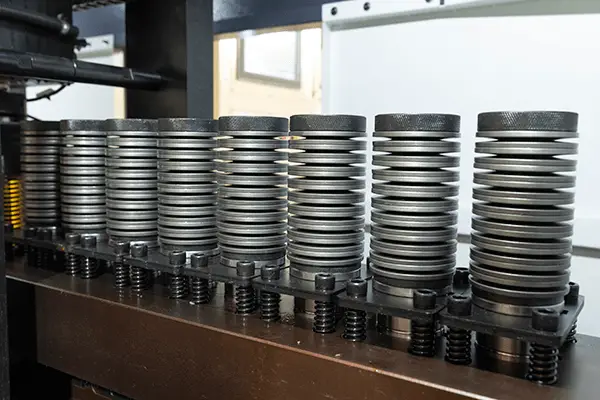
Precision-machined guideways and high-strength tooling assemblies further enhance mechanical stability. Hardened punches maintain sharp cutting profiles during repeated operations, while precision bending dies ensure smooth curvature without surface deformation. Through this structural integrity, the machine maintains consistent operational accuracy even under demanding industrial workloads.
Intelligent Tooling and Operational Flexibility
Modern manufacturing environments require adaptability. The LiJian® 3 in 1 busbar machine incorporates modular tooling systems that allow rapid transitions between different hole patterns, bend angles, and material dimensions. This flexibility supports a wide range of busbar configurations used in electrical distribution equipment.
Furthermore, advanced control software assists operators in optimizing processing parameters. The system facilitates efficient setup procedures and reduces the likelihood of dimensional errors during production. Consequently, fabrication facilities can accommodate both standardized components and customized electrical designs with equal precision.
Industrial Applications and Manufacturing Advantages
Switchgear and Electrical Distribution Manufacturing
Switchgear systems demand highly accurate busbar components to ensure safe and efficient current transmission. The LiJian® 3 in 1 busbar machine enables manufacturers to produce precisely punched and bent busbars that integrate seamlessly into compact cabinet structures. Accurate fabrication improves installation efficiency and strengthens electrical reliability.
Renewable Energy Infrastructure
The rapid expansion of renewable energy technologies has intensified the demand for sophisticated electrical distribution systems. Solar power converters, wind energy control units, and energy storage modules rely on complex busbar networks to manage high-current transmission. Integrated busbar processing equipment supports the efficient production of these conductive components.
Enhanced Manufacturing Productivity
Automation significantly improves production capacity. The LiJian® 3 in 1 busbar machine reduces manual intervention and minimizes material handling steps. Consequently, fabrication cycles become faster and more predictable. Manufacturers benefit from reduced labor requirements, improved consistency, and greater scalability in busbar production.
Technological Significance in Electrical Manufacturing
Electrical infrastructure continues to evolve in response to increasing energy demands and technological innovation. Within this context, fabrication equipment must provide both precision and operational efficiency. The LiJian® 3 in 1 busbar machine exemplifies this convergence of advanced engineering and integrated processing capability.
Through the combination of CNC control, structural robustness, and multifunctional processing architecture, this equipment enables manufacturers to produce high-quality busbar components with remarkable consistency. In doing so, it contributes to the reliability and performance of modern electrical distribution systems while supporting the ongoing advancement of industrial manufacturing technologies.