Why Busbar Precision is Critical in Electrical Workshops
Electrical panel builders operate within strict dimensional limits. Consequently, busbars must align perfectly with breakers, terminals, and insulation supports, typically without any room for adjustment. Even a minor deviation can significantly slow installation and negatively impact conductivity. For this reason, modern workshops now depend on dedicated busbar machines instead of error-prone manual tools.
Furthermore, switchgear and panel layouts continue to grow denser. As internal space shrinks, busbars must follow exact, predefined paths. This trend, therefore, dramatically increases the need for reliable and repeatable processing equipment.
The Core Function of Busbars in Panels and Switchgear
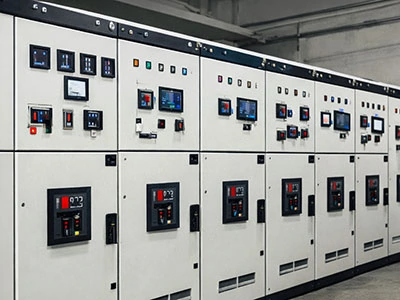
Primarily, busbars distribute power across the entire electrical system. Simultaneously, they stabilize heat flow and maintain optimal electrical balance. Because of this dual role, fabricators must produce busbars with clean edges, accurate holes, and precise bends every time.
In addition, consistent geometry greatly speeds up assembly. Workers can install parts much faster when dimensions remain uniform from one piece to the next. Consequently, overall production efficiency improves noticeably.
How a Modern Busbar Machine Transforms Fabrication Quality
Replacing Manual Steps with Automated, Controlled Operations
Traditionally, workers measured, drilled, cut, and bent busbars entirely by hand. However, this manual method inevitably created inconsistencies and wasted material. In contrast, a modern CNC busbar machine replaces guesswork with programmed mechanical control and digital positioning.
As a result, workshops achieve stable, high quality across every production batch. Operators can then focus on supervising the streamlined process instead of constantly correcting errors.
Three Essential Operations in One Integrated System
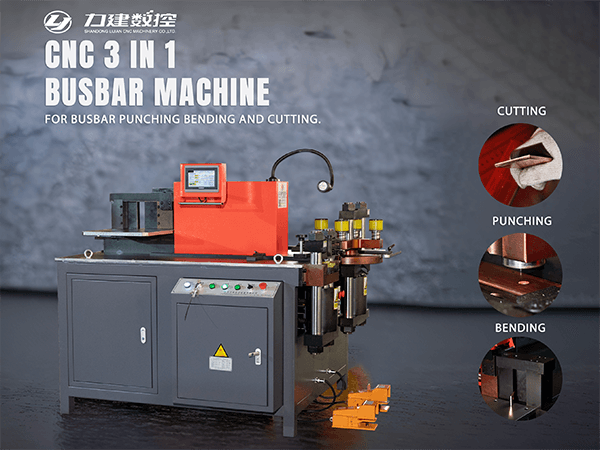
A professional busbar machine efficiently completes three critical tasks in one smooth, continuous sequence.
1. Accurate Punching for Flawless Mounting Holes
The punching unit creates clean holes that match design drawings exactly. Operators simply set positions via the control panel, and the machine executes the pattern with precision. Therefore, alignment issues rarely occur during final assembly.
2. Consistent Bending for Compact Panel Installations
Next, the bending unit forms busbars to exact angles without stressing the material. This consistency ensures busbars fit easily inside increasingly narrow enclosures.
3. Clean Cutting for Safe and Fast Handling
Finally, the cutting system produces smooth, deburred edges. Because of this, workers handle parts more safely and drastically reduce secondary finishing time.
CNC Control and Flexible Tooling: The Efficiency Drivers
Digital Input Drastically Reduces Setup Time
CNC control allows operators to enter dimensions directly. Since programs store common designs, the machine can repeat jobs instantly. Consequently, setup time decreases while accuracy and repeatability increase.
Tooling Adaptability for Diverse Sizes
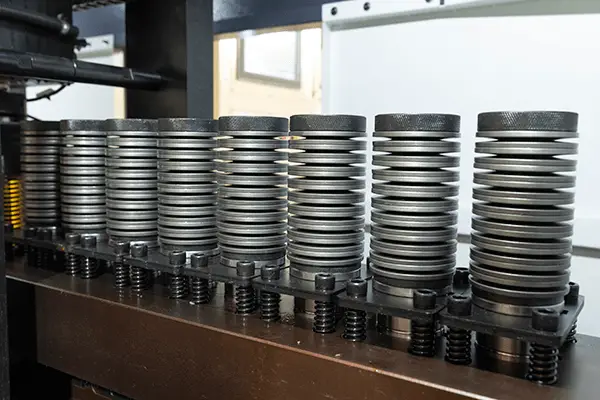
Panel workshops regularly process various busbar widths and thicknesses. Thankfully, interchangeable tooling lets a single machine handle all these variations efficiently without compromise.
Full Compatibility with Copper and Aluminum
Manufacturers commonly use both copper and aluminum. A high-quality busbar machine processes both materials with equal precision, which significantly simplifies production planning and inventory management.
Key Productivity and Safety Benefits for Your Workshop
Higher Output with Fewer Operators
Automation reduces direct manual labor. In fact, one operator can often manage the entire punching, bending, and cutting workflow. Meanwhile, overall production speed rises significantly.
Reduced Waste and Lower Operating Costs
Precise cutting and punching minimize material scrap. Over time, this efficiency lowers raw material costs and virtually eliminates costly rework.
Inherently Improved Safety During Operation
Modern machines come with protective guards, emergency stop systems, and stable clamping devices. Together, these features actively create a much safer working environment.
Crucial Considerations When Selecting a Busbar Machine
Evaluate Capacity, Automation, and Future Needs
Buyers must carefully evaluate maximum busbar size, automation level, tooling options, and future expansion plans. Ignoring these factors often leads to costly limitations later on.
Avoiding Common Mistakes During Equipment Selection
Some workshops focus only on the initial purchase price. Others overlook their long-term production goals. However, a well-chosen machine strategically supports business growth and improves efficiency for years to come.
Why the LiJian® Busbar Machine is a Practical Alternative
Integrated 3-in-1 Busbar Machine Design for a Smoother Workflow
The LiJian® busbar machine combines punching, bending, and cutting in one compact platform. Therefore, workshops save valuable floor space and dramatically improve operational flow.
Stable Accuracy that Meets Electrical Panel Standards
LiJian® equipment delivers consistent hole positioning, precise angles, and clean cuts, ensuring output meets the strictest panel fabrication standards.
Reliable Performance for Demanding Continuous Production
LiJian® machines handle heavy workloads while maintaining consistent speed and stability. This robust performance makes them perfectly suited for busy electrical workshops.
Conclusion
In summary, a capable busbar machine plays a central role in modern panel and switchgear fabrication. It directly improves precision, reduces labor, and increases production speed. Furthermore, intelligent CNC control and flexible tooling help workshops adapt to different project requirements with ease. With its integrated design and dependable performance, the LiJian® busbar machine presents a highly effective solution for accurate, efficient, and profitable busbar processing.