Introduction: Powering the EV Revolution
Firstly, The rapid expansion of Electric Vehicle (EV) charging networks, from fast-charging stations to depot chargers, requires a massive amount of power distribution hardware. At the heart of this hardware are busbars designed for high power, modularity, and safe operation. This article explores how efficient busbar fabrication supports the scalability and reliability needed for the global EV charging rollout.
Fabrication for High-Power Density and Safety
EV chargers pack immense power into compact cabinets, making busbar design and quality paramount.
Achieving Compact, Efficient Layouts
To minimize cabinet size, busbars must follow complex, three-dimensional paths to connect contactors, breakers, and power modules. This requires a fabrication machine with excellent spatial bending capabilities. The ability to produce accurate, repeatable multi-plane bends in a single setup allows engineers to design compact, efficient busbar layouts that save space and reduce overall system cost.
Prioritizing Safety Through Precision
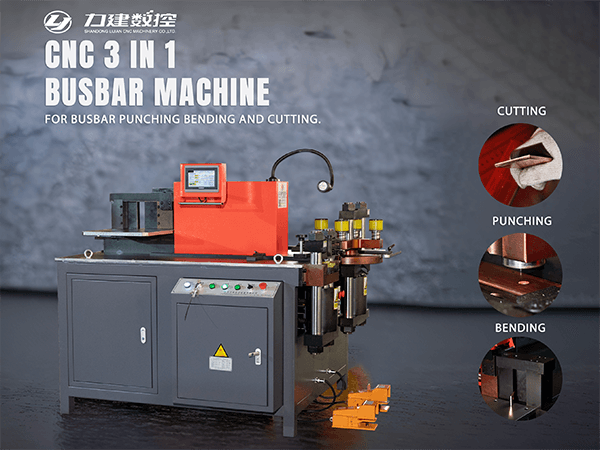
Safety is the top priority. Any sharp edge, burr, or improper clearance created during fabrication can become a risk in the high-voltage environment of a charger. Precision punching and shearing that delivers clean, deburred edges is a critical safety feature. By using equipment engineered for quality like LiJian® machines, manufacturers inherently build a higher safety standard into their product from the very first production step.
Supporting Scalable and Modular Manufacturing
Charger manufacturers need to scale production rapidly and often use modular designs to cover different power levels.
Consistency for Modular Design Platforms
A modular product line uses many common busbar components across different models. The CNC repeatability of a modern busbar machine ensures that these common parts are identical every time, regardless of production batch or factory location. This consistency is vital for maintaining quality, simplifying inventory, and enabling flexible manufacturing lines that can assemble different charger variants seamlessly.
Speed for Meeting Market Demand
The market demand for charging infrastructure is surging. Therefore, production throughput directly impacts a company’s ability to capture market share. A high-speed busbar processing machine acts as a force multiplier, enabling the fabrication of hundreds of precise components per shift. This capacity allows charger OEMs to respond to large orders and dynamic market needs confidently, knowing their core component supply is secure and efficient.
Conclusion: Building the Backbone of E-Mobility
Finally, the transition to electric mobility relies on a robust, ubiquitous charging network. The companies that build this network depend, in turn, on reliable suppliers who can deliver critical components like busbars at scale and with uncompromising quality. By mastering busbar fabrication with advanced, reliable technology, manufacturers position themselves as essential partners in this historic infrastructure project, driving growth while contributing to a sustainable future.
Shandong Lijian CNC Machinery Co., Ltd.