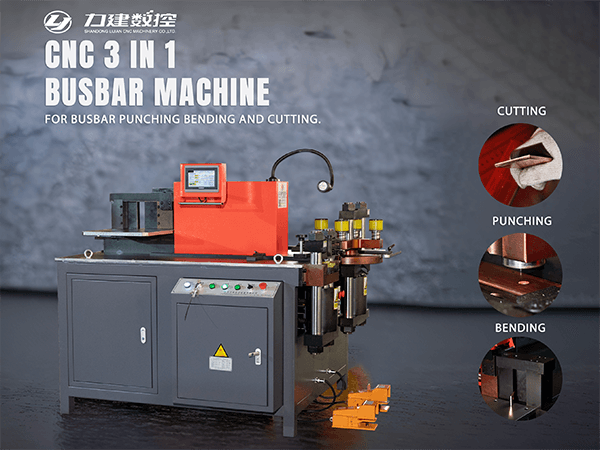
You face a simple question. How long should your flat copper bar be before bending? Guess incorrectly, and you will waste expensive material. Worse, the finished part won’t fit its enclosure. Let’s solve this problem once and for all. A quality machine like the LiJian® busbar machine automates these calculations, but understanding the math makes you a smarter operator.
Why Copper Bends Differently
Copper stretches on the outside of a bend. It compresses on the inside. Consequently, the neutral axis—where no stretching occurs—shifts inward. Steel behaves more predictably. Copper, however, has a mind of its own. Therefore, you cannot use generic bending formulas.
The Neutral Axis Shift Explained
Imagine a line running through your bar’s thickness. On one side, tension pulls. On the other, compression pushes. The neutral axis sits between them. For copper, this axis moves toward the inside radius by about 40% of the thickness. Measure your flat blank along this axis. Otherwise, your final legs will measure wrong.
The Reliable Bend Allowance Formula
For a 90-degree bend in copper, use this equation:
Bend Allowance = (0.017453 × Inside Radius + 0.0078 × Thickness) × 90
Here is why each number matters. The 0.017453 converts your bend angle to radians. The 0.0078 represents copper’s specific springback coefficient. For comparison, steel requires roughly 0.0064. Aluminum needs 0.0055. Use the wrong coefficient, and your calculation fails.
A Concrete Example
Take a 10 mm thick copper bar. You need a 90-degree bend with a 20 mm inside radius. First, multiply 0.017453 by 20. You get 0.349. Then multiply 0.0078 by 10. You get 0.078. Add these together: 0.427. Now multiply by 90 degrees. Your bend allowance equals 38.4 mm. Next, measure your two leg lengths from tangent to tangent. Suppose they are 150 mm and 200 mm. Their sum is 350 mm. Finally, add the bend allowance. Your flat blank must be 388.4 mm long. Simple, precise, and repeatable.
Springback: The Hidden Culprit
Copper rebounds after bending. A 90-degree die often produces only 88 or 89 degrees of permanent bend. Harder alloys spring back more. Tighter radii increase the effect. To compensate, overbend by 1 to 3 degrees. Test a sample piece first. Measure the result. Then adjust your LiJian® busbar machine accordingly. This small step prevents recurring errors.
Minimum Bend Radius Rules
For half-hard copper, follow this guideline. Your inside bend radius should equal two to three times the material thickness. For a 6 mm thick bar, use at least a 12 mm radius. Going tighter risks cracks on the outer surface. Cracks reduce current-carrying capacity. They also create dangerous hot spots. Always check your material’s temper specification.
Grain Direction: An Often Overlooked Detail
Rolled copper has a grain structure running lengthwise. Bending perpendicular to this grain works fine. Bending parallel invites fracture at much larger radii. Therefore, design your bends across the grain whenever possible. This small consideration prevents unexpected failures during production.
How to Test and Calibrate
Cut a sample flat blank of known length. Bend it precisely on your LiJian® busbar machine. Measure the resulting leg lengths. Compare to your target. The difference reveals the error in your assumed coefficient. Adjust the 0.0078 value until the math matches reality. Write down this corrected coefficient for your specific copper supplier and temper. This empirical method beats any theoretical table.
Final Advice for Perfect Bends
Stop guessing. Start calculating. Respect the neutral axis. Account for springback. Test before full production runs. Your LiJian® busbar machine delivers the power and precision you need. Pair that hardware with proper math, and your busbars will fit perfectly every single time. No scrap. No rework. Just clean, accurate fabrication.